

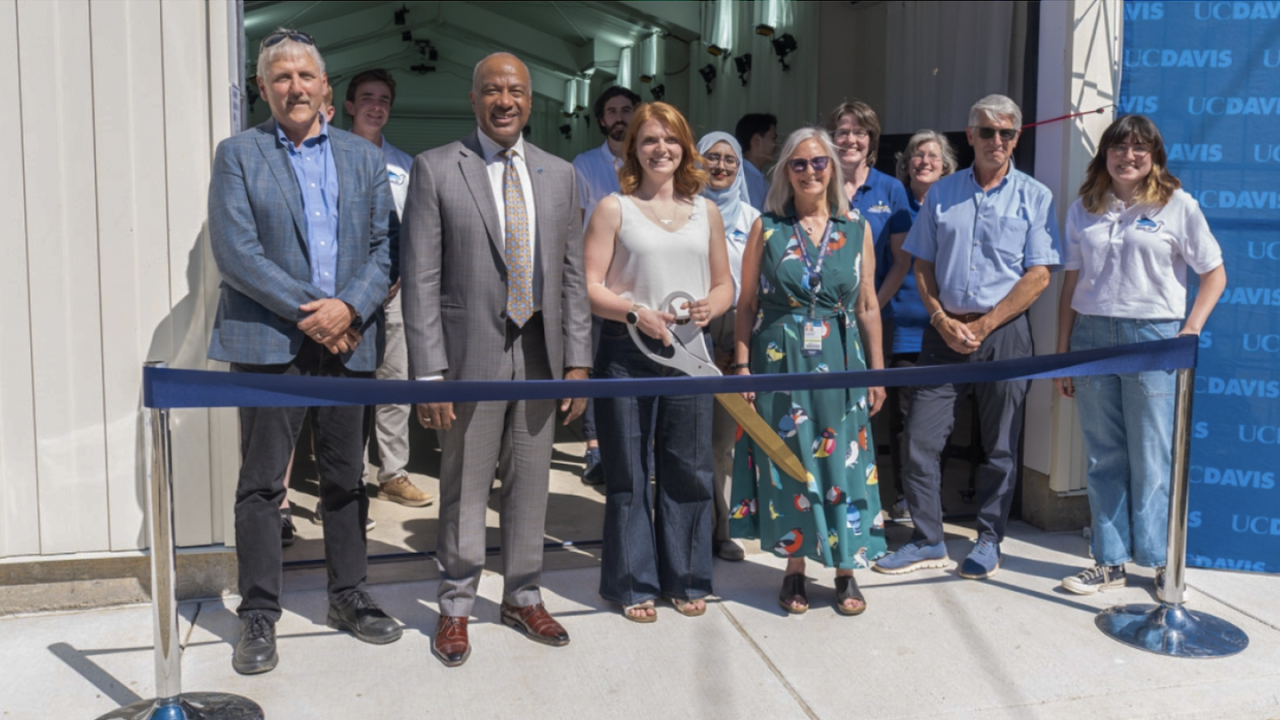
Center for Animal Locomotion and Innovation, Grand Opening
The Center for Animal Locomotion and Innovation represents the power and potential of our university. As we celebrate its opening today, we celebrate something uniquely UC Davis.
Only here would veterinarians, aerospace engineers, wildlife experts and students come together to study how birds fly — not just to understand nature, but to improve animal rehabilitation and even inspire next-generation drone technology.
This approach demonstrates our commitment to cross-disciplinary work that advances our understanding of the world.
It represents the best in student preparation through hands-on learning, and it affirms the power of partnerships to achieve incredible results.
The CALI facility embodies our belief that the solutions to the challenges we face are best found when we work across disciplines. When we harness the power of our engineering program and the insights from our School of Veterinary Medicine, we do more than combine their expertise.
We multiply it. And we bring entirely new approaches to life.
This combined expertise will fuel breakthroughs. We’ll expand on our work to detect, prevent and fight wildfires. We’ll extend our capacity to develop more sustainable models of flight.
The Center also embodies our commitment to our students. The Center will empower students to engage in hands-on research that translates to careers and their own scholarship.
CALI is more than a research facility; it is a training ground for the next generation of researchers and entrepreneurs.
Students will work at the leading edge of biomechanics, engineering, and robotics, building their skills and understanding.
At the heart of this new facility and UC Davis is the belief that when we give our students the chance to work on the frontiers of knowledge, we lay the foundation for their future success.
I can’t wait to see what ideas take flight in the years to come.
This new facility rests on another UC Davis value: partnership. It was born in the work of Christina Harvey and Michelle Hawkins. It was solidified in the partnership between Dean Stetter and Dean Corsi and their committed teams.
And it was brought to life through a partnership with the Design and Construction Management team. They collaborated with the researchers throughout, from the grant application through construction, making today’s celebration possible.
Outside of campus, we worked with the U.S. Army Combat Capabilities Development Command Army Research Office to fund the project.
That partnership reminds us of the power of mutual support between the federal government and universities like ours. Their support for cutting-edge research empowers us to build new understanding and deliver results for the people of California and the whole country.
The power of local partnerships is on full display at this celebration, as well ... We’re also joined by the California Hawking Club and many volunteers from the California Raptor Center, both groups with birds on gloves who have volunteered their time to partner with us.
I hope you have the chance to see the incredible birds they’ve brought and admire their skill in handling them.
Thank you all for joining us today for this celebration.