

The Committee to Honor Patwin and Native Americans at UC Davis launched in 2000 to develop and implement a plan that would ensure the Patwin people, in the past and the future, would be acknowledged, and that monuments would be placed across the campus to honor the Patwin. Through a competitive process, UC Davis selected Far Western Anthropological Research Group, which developed the “Plan for the UC Davis Project to Honor Native Americans” in May 2006. The project plan identified a series of outdoor installations at 11 sites on the UC Davis campus.
Installations
Native American Contemplative Garden
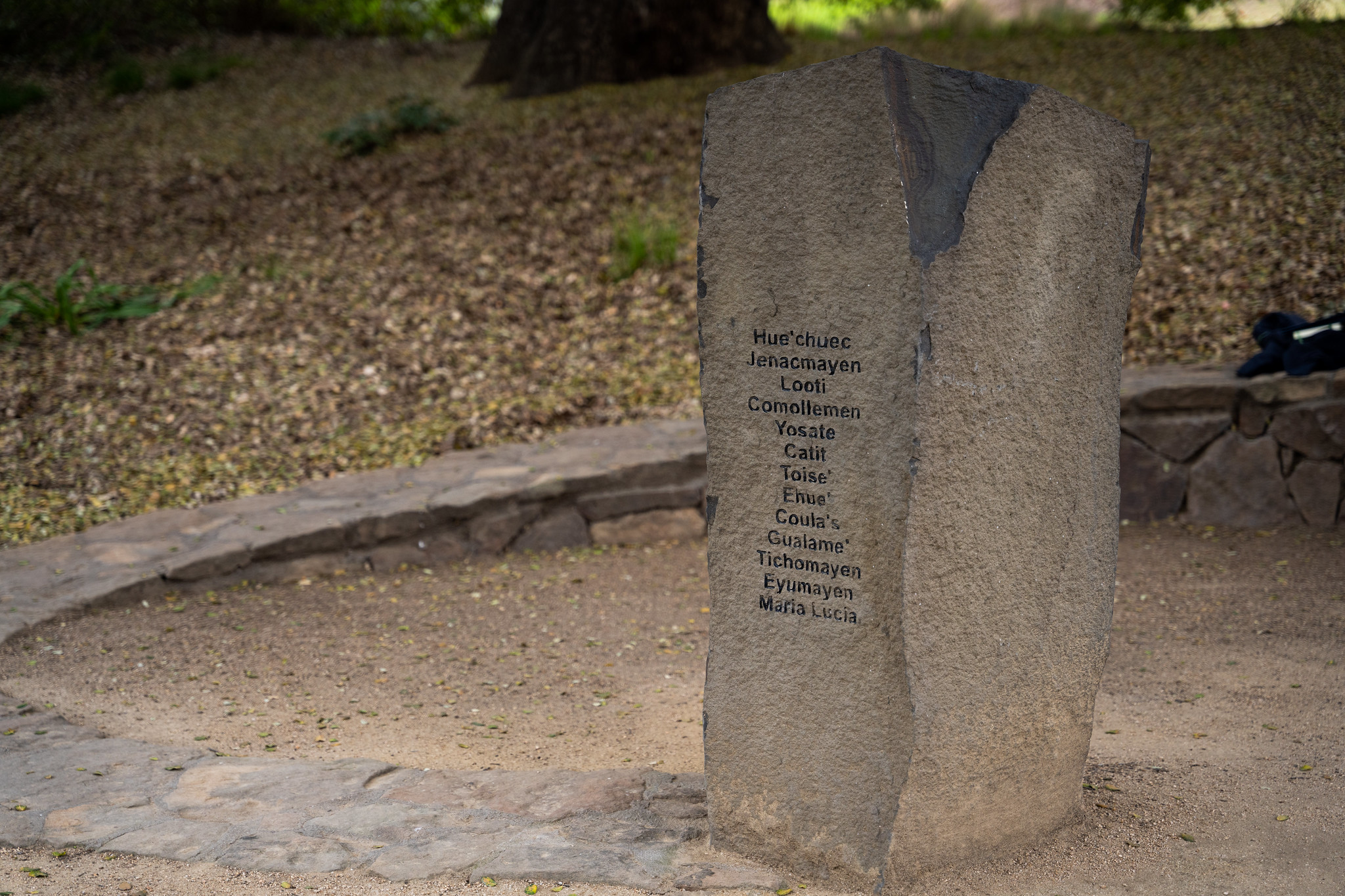
The first exterior installation in the project to be completed was the Native American Contemplative Garden in the UC Davis Arboretum, which was dedicated in 2009.
Inscriptions on basalt columns, written by Patwin Elder Bill Wright and his family, provide a sense of place, transporting visitors to a time when the Patwin inhabited the land along Putah Creek that is now part of UC Davis. The basalt columns line the garden path in the shape of a coil, designed to emulate the start of a woven basket. The garden honors the Patwin ancestors who lived on the land.
Hundreds of Patwin villages also lined the many creeks that traverse this land from Glenn County to the San Francisco Bay. Today, the old villages are gone and only three federally recognized Patwin and Wintun Indian Rancherias remain: the Colusa Tribe, the Cortina Tribe, and the Yocha-De-He Wintun Nation.
Prayer Stone

The second monument is a granite plaque unveiled in 2019 near the entrance to the Mondavi Center for the Performing Arts during a ceremony titled, “Voices, Drums, Whistles. Sing, Dance, Remember.” The plaque, referred to as the "Prayer Stone," features an excerpt of a prayer delivered by Patwin Elder Bill Wright during the Mondavi Center’s dedication in 2002, which reads “Grandfather. Bless all the people who gather here today. Help us to understand and get along in this world. Bless the grounds that these buildings stand on. Those that are gone – the spirits from this land – help those who come through here. Maybe one day, they will understand about the other world, your world. As the students come through here, Grandfather, give them the understanding and knowledge that they search for, and help them grow. I know that the spirits from this land hear me, and they have a right to be angry for what was done to them. But we will give them our respect, and they will respect us, as earthly people. Mistakes were made, but they will forgive us. Grandfather, look over us, and guide us and give us a good day. -O.”
Committee member and Elder Bill Wright died in September 2021 at the age of 84.
Tree Planting Ceremony

Late in 2021, an 85-year-old California buckeye that was an iconic feature of the Native American Contemplative Garden broke apart due to old age. Original members of the Committee to Honor the Patwin and Native Americans, along with Arboretum and Public Garden horticulturists, decided to leave the trunk in place and incorporate it into the garden’s design. A tree planting ceremony was held in early 2022, during which members of the original committee and other attendees helped to plant buckeye saplings and a Western redbud near the fallen tree.
Future Installations
Details related to future installations will be shared with the campus community.